Evaluating Arizona Vintage Retro Assets for Commercial Print Design
The market for nostalgic apparel and regional merchandise has matured significantly, moving beyond simple souvenir shop aesthetics into a sophisticated design niche. Within this space, the Arizona Vintage Retro collection represents a specific category of digital assets tailored for print-on-demand (POD) entrepreneurs and professional designers. Unlike generic clip art, these resources are engineered with production specifications in mind, addressing the technical friction points that often plague commercial printing workflows. For creators targeting the Southwestern aesthetic or capitalizing on the enduring popularity of retro Americana, understanding the practical utility of this asset pack is essential for maintaining quality standards and operational efficiency.
At its core, Arizona Vintage Retro is not merely a set of images; it is a production-ready toolkit. The value proposition lies in the intersection of aesthetic authenticity and technical compliance. When evaluating design resources for platforms like Printful or Teespring, the primary concern is rarely just how good an image looks on a screen, but how reliably it translates to physical media. This collection addresses that gap by providing files that adhere to strict industry benchmarks, reducing the need for extensive pre-press correction and minimizing the risk of rejected uploads or poor-quality prints.
Technical Specifications and Production Readiness
The most critical aspect of any POD asset is resolution. Many vintage-style graphics found online suffer from compression artifacts or insufficient pixel density, resulting in muddy prints when scaled to garment size. The Arizona Vintage Retro assets are standardized at 4500 px by 5400 px. This dimension is significant because it aligns directly with the maximum print area requirements of major fulfillment providers. By starting at this native resolution, designers avoid the pitfalls of upscaling, which often introduces blur and noise. Furthermore, the files are rendered at 300 DPI (dots per inch), the non-negotiable standard for professional textile printing. This ensures that halftones remain crisp, text stays legible, and color transitions appear smooth rather than pixelated.
Beyond resolution, file format versatility dictates workflow speed. This collection includes transparent background PNG files, which serve as the immediate workhorse for most POD sellers. The transparency is clean, without jagged edges or residual white halos that can ruin a print on dark garments. This allows for direct upload to platforms like Teespring and Printful without additional editing. However, the inclusion of AI and EPS source files elevates the utility for professional designers. Vector-based or layered source files allow for non-destructive editing, enabling users to adjust colors to match specific brand palettes, resize elements infinitely without quality loss, or isolate specific components for composite designs. This dual-format approach caters to both high-volume sellers who need speed and boutique designers who require customization.
Aesthetic Authenticity and Market Positioning
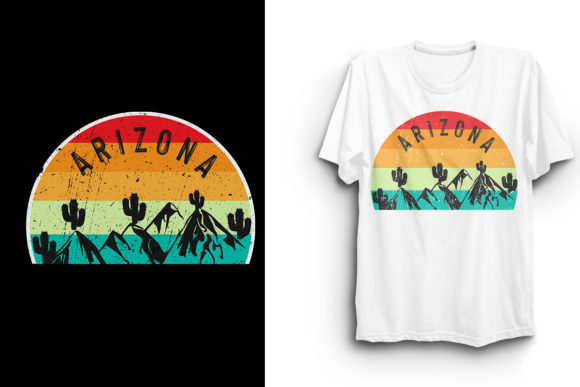
In the vintage retro niche, authenticity is the primary differentiator between best-sellers and ignored listings. Consumers in this demographic possess a keen eye for anachronisms; they can distinguish between genuine mid-century inspiration and modern imitation. Arizona Vintage Retro assets typically utilize period-accurate typography, color grading, and texture overlays that mimic analog printing techniques. The distressing effects are generally applied thoughtfully, avoiding the repetitive patterns that characterize low-effort automated filters. This attention to detail helps establish credibility with buyers seeking genuine nostalgia rather than costume-party kitsch.
The visual language of these assets also considers current merchandising trends. While rooted in historical reference, the compositions are often balanced for modern garment placement. Center-chest prints, pocket-sized logos, and back-piece layouts are common considerations in professional asset design. The color palettes tend toward muted earth tones, desert hues, and faded primaries that complement popular apparel blanks like heather grey, sand, and olive. This practical color theory reduces the cognitive load for sellers trying to match designs to inventory, ensuring the final product looks cohesive and intentional.
Workflow Integration for POD Platforms
For users of Printful and Teespring, consistency is key to scaling a business. Managing hundreds of SKUs requires assets that behave predictably across different products. The 4500x5400 px sizing of Arizona Vintage Retro files provides a safe zone that accommodates various garment sizes and cut-and-sew variations. When a design is optimized for this canvas, it minimizes the risk of important elements being cropped during production or appearing disproportionately small on larger sizes like 3XL or 4XL.
The inclusion of source files also facilitates cross-platform diversification. A seller might use the transparent PNG for a t-shirt on Teespring but utilize the AI file to create a matching sticker, mug wrap, or poster layout for Etsy. Because the vector or layered data remains intact, the design system remains consistent across product categories without requiring a complete redesign. This interoperability is crucial for building a recognizable brand identity rather than just selling disparate graphic tees. Additionally, having editable source files future-proofs the investment; if platform requirements change or new printing technologies emerge, the original assets can be adapted without repurchasing or recreating them from scratch.
Strategic Value for Different User Segments
Different stakeholders derive distinct benefits from this type of asset collection. For freelancers and agency designers, the source files reduce billable hours spent on illustration and pre-press setup. Instead of drawing a vintage cactus motif from scratch, a designer can license a high-quality base and customize it, passing savings to clients while maintaining healthy margins. The reliability of the 300 DPI specification also protects the designer’s reputation by preventing client complaints about print quality.
For small business owners and POD sellers, the primary value is risk mitigation and speed-to-market. Testing new niches requires rapid iteration. Having a library of professionally vetted, print-ready Arizona Vintage Retro graphics allows for quick listing creation to validate market demand before investing in custom illustrations. The transparent PNGs eliminate the need for advanced Photoshop skills, lowering the barrier to entry for entrepreneurs who excel at marketing but lack technical design training.
Educators and content creators may find value in these assets for presentation materials, course thumbnails, or blog headers related to Southwestern history, design theory, or regional tourism. The high resolution ensures clarity in digital formats, while the vintage aesthetic adds visual interest without distracting from educational content. The licensing terms typically associated with such packs usually cover digital display, making them versatile for multimedia projects beyond apparel.
Practical Considerations and Limitations
While Arizona Vintage Retro assets offer substantial advantages, objective evaluation requires acknowledging limitations. First, the "vintage" aesthetic is inherently restrictive. These assets are unsuitable for brands targeting Gen Z Y2K trends, corporate minimalism, or hyper-modern streetwear. Users must ensure the style aligns with their specific audience demographics before acquisition. Second, because these are licensed assets rather than exclusive commissions, there is a possibility of market saturation if multiple sellers use unmodified versions. Professional users should leverage the included AI/EPS files to alter colors, rearrange elements, or combine assets to create unique derivatives. Relying solely on the pre-made PNGs increases the likelihood of duplicate content issues on competitive marketplaces.
Additionally, users should verify color profiles. While 300 DPI ensures sharpness, POD platforms typically require CMYK or specific RGB profiles for accurate color reproduction. Some vintage assets are designed in RGB for screen vibrancy; professionals should check whether conversion is necessary to prevent unexpected color shifts, particularly with neon or highly saturated retro hues. Finally, always review the specific license agreement regarding trademark usage. While the art itself may be cleared, combining it with certain phrases or branding could still infringe on existing intellectual property. Due diligence remains the responsibility of the user.
Final Assessment of Utility and Quality
Arizona Vintage Retro assets represent a functional solution to specific production challenges in the print-on-demand ecosystem. They succeed not by being revolutionary, but by being reliably competent. The combination of 4500x5400 px dimensions, 300 DPI resolution, and multi-format delivery demonstrates an understanding of professional workflow requirements that many free or low-cost alternatives lack. For adults aged 20–50 engaged in commercial creative work, these assets function as infrastructure rather than mere decoration. They provide a stable foundation upon which viable products can be built, tested, and scaled.
Ultimately, the decision to incorporate these resources should be based on workflow efficiency and quality assurance needs. If your current process involves frequent resizing, background removal, or dealing with print rejection notices, upgrading to professionally specified assets offers a tangible return on investment. Conversely, if you are a hobbyist creating one-off personal projects or a designer who prefers hand-drawn exclusivity, the utility may be lower. However, for serious marketers, publishers, and entrepreneurs operating in the Southwestern retro niche, this collection delivers the technical precision and aesthetic coherence necessary to compete in a mature marketplace. It bridges the gap between creative vision and manufacturing reality, allowing creators to focus on strategy and sales rather than file preparation.